


There's a nervous excitement. I can see the chilled vapour exhaled by my rivals as they perform the "pre-race" shuffle on the beginning point.
A rapid twitch of the hips.
I'm at my local Saturday morning race and I'm serious. The countdown begins...
Hold on. I must start my tracker. So does the runner beside me.
The person in the line sighs. I refuse to go until… done! GPS ready, and I'm running.
Amidst the crowd, it's difficult to find a wrist without a fitness tracker on it. And this isn't only us participants who wear them.
It's a thriving, multi-billion pound industry. Brands like Samsung Galaxy are prevalent, each with an extensive selection of different models to fit a spectrum of budgets. Depending on how advanced the device you choose, prices can range from a hundred pounds to a significant investment.
"It makes me crazy, it's impossible to stop checking."
"It comforts me… It feels like a supporter guiding me."
"I wish it wouldn't say I've had a restless night."
A handful of the reactions I've received from other tracker enthusiasts when I question what they think of theirs.
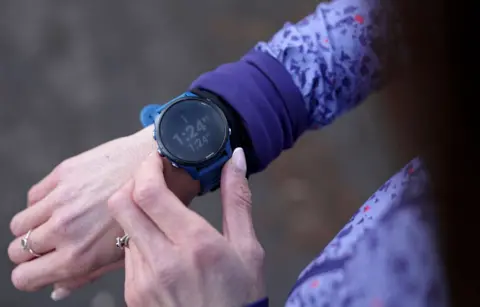
A Sea of Statistics
My feelings on my own device? Right now, frustrating. It's telling me my speed is wrong, leading me to doubt whether the foliage I'm running below are interfering with my satellite signal.
Countless individuals of us attach these small gadgets onto our wrists and wear them 24/7, ostensibly comfortable with the fact they're perpetually tracking us.
Gone are the days when we used them exclusively to give us an idea of our pedometer reading. Currently, they can analyse our sleep quality, heart rate, glucose levels, our recovery score.
It's a challenge to find a bodily function they fail to monitor.
But can they do what they claim to do? And are the statistics we analyse a accurate representation of the truth? Do they improve our daily wellness, or do the multitude of metrics and motivational messages just contribute to our sense of overwhelm?

Addiction or Aid?
"I find myself getting a a little preoccupied with mine," a wearer reveals.
While she loves how her device tracks her exercise, she finds some of its other features "excessive" at times - a feeling that became apparent during a pregnancy.
Until she found out she could put it into a specific mode, her smartwatch kept telling her she was failing to be energetic enough. In a new phase, the watch insists her she's had a restless night.
"I have a infant, there's no point to be notified I'm tired," she says. "That fact is all too clearly."
Couldn't she just take it off?
"I suppose I could, I suppose, but I have this push-pull dynamic with it," she continues. "I love it for its fitness insights, I sometimes question whether the additional features it can now do is possibly too much for me."
Inside the Device
Every device of smartwatch has its own novel way of monitoring your vitals and interpreting your data, but the most use sensors on the back of the watch.
They commonly shine tiny, coloured LED lights onto your arm which can observe pulsation, detecting your BPM. More advanced devices measure changes in the bioimpedance that flows through the skin to get an idea of your recovery state.
A Fine Balance
A professor says that in general for smartwatches, it's a "difficult line" - while the continuously improving tech could actually aid early diagnosis, "identifying issues before we notice anything", it could also turn us the tracked into the "concerned but fine".
He points out that some of the latest wearables can perform tests like electrocardiograms (ECGs), which regularly monitor how healthy the heart is. They can flag if someone is experiencing an irregular rhythm, where there is irregular impulses in the heart causing an irregular heartbeat.
This does not mean someone is about to have a heart attack, but it can give an preliminary indication they might be more susceptible of a stroke in the years to come.
But how to interpret these numbers is complicated. The expert concerns that as more functions are introduced, people may find it hard to fully contextualise their data.
"I have some doubts that the ability to monitor so many metrics is such a good idea," he says.
A health researcher studying wearable tech echoes this sentiment. A study into the influence of wearable tech on a cohort of cardiovascular patients suggested a minority of those who were given devices to monitor their cardiac function experienced heightened worry and were "had a higher tendency to use doctor's time".
She observed a vicious circle with her patients - they spotted a concerning reading on their watch. They grew concerned. Their pulse increased. They got more worried. They checked again, and their heart rate rose further.
"When people are presented with data about ourselves that we lack context for then, of course, we are going to want to know more," the psychologist says. "We look, we obsess - it becomes a feedback loop."


